The problem with AI scare stories is that AI is too stupid to hurt you

Richard Wallace

While you sleep, robots are taking over your job and shady tech corporations are developing Skynet-style AI networks who will eventually drag us all into a terrifying singularity or, worse, unleash uncontrollable hordes of super-smart cyborg dogs.

Or at least, that’s what the news would have you believe. Consider the alarmist notes in these headlines: “AI Is Inventing Languages Humans Can’t Understand. Should We Stop It?” from Fast Company, and “AI will displace 40 percent of world’s jobs in as soon as 15 years,” from CBS news [note: the heading has been softened as of Jan 13th, but the original remains visible in the slug attached to this link.] 

The articles are interesting, and their concerns are quietly relevant — but they may well be inflated in terms of the immediate danger. In fact, The Guardian reports that the Fast Company story was highly significant among experts, but misleadingly framed to the public. Or, as Zachary Lipton, an assistant professor at the machine learning department at Carnegie Mellon University, more succinctly puts it, journalists took the findings from “potentially interesting research to sensationalised crap.”

What the papers aren’t telling us – or are burying below provocative headlines – is that while AI is a hugely powerful tool that already raises some revolutionary possibilities for businesses and users alike, the sci-fi dystopia version of AI that we’re all imagining is still a long way off.

Yes, Stephen Hawking may have considered AI an existential threat to humanity. But to that, we say: here’s a blooper reel of robots falling over at the DARPA robotics competition a few years back, set to jaunty ragtime piano. Ooooh, we’re so scared.

Okay, to be fair these robotic quadrapeds from Boston Dynamics are pretty unsettling, but unless you’re a door handle, you’re probably safe for now. And as for other forms of AI? Well, the CEO of Waymo, John Krafcik, said earlier this month that true ‘level five’ driverless cars will simply never happen – and as he’s the CEO of a driverless car company, we should probably listen. (Level five involves cars navigating all types of road without human input – currently we’re somewhere between levels three and four, both of which require human intervention). 

The driverless car issue highlights one of the fundamental barriers between where we are now and full AI capabilities. AI may be able to reliably perform predesignated tasks and even learn behaviours, but machines do this through observation — when confronted with new and unfamiliar situation, such as a challenging road or unusual obstacle, they will simply fail, unlike (most) human judgement.

So why is the press so hot on selling us visions of a dystopian future? Well, for one thing, readers love scare stories, and papers love readers. It’s especially easy to sensationalise in an environment when many of us don’t understand the complexities of the technology. But another reason is that journalists often don’t fully understand the technology themselves. Researchers often inflate the importance of their findings, and the complexity of the field makes it nearly impossible for laypeople to accurately report.

As the Guardian notes, this kind of breakdown in communication between experts, scribes and readers is hardly a novel feature of tech reporting.

“It was a similar story in the United States after Frank Rosenblatt, an engineer at Cornell Aeronautical Laboratory, presented a rudimentary machine-learning algorithm called the “perceptron” to the press in 1958. While the “perceptron” could only be trained to recognise a limited range of patterns, the New York Times published an article claiming that the algorithm was an “electronic brain” that could “teach itself”, and would one day soon “be able to walk, talk, see, write, reproduce itself and be conscious of its own existence”.”

Even now, sixty years after the perceptron, we haven’t reached the point of machine consciousness — and we’re not even close. 

Should we be worried?

Well, yes — a little bit. But not for the reasons we might think.

Automation is creeping into the public space all the time, most notably in the self-service outlets we see at supermarkets and fast food restaurants. Some industries – notably those that require repetitive manual tasks or long-distance driving – are more at risk than others. But we’re still a long way from fully-automated luxury communism, and experts agree that automation will create new job opportunities as we move towards a new type of labour market. In any case, the pros and cons of automation are more complicated that “Robots are taking our jobs”, as Forbes reported last September (after running an article in March titled, “Robots are not taking our jobs.” What changed in six months?!) 

The more immediate worries with AI come from data security. Last year Amazon’s Alexa transmitted a private conversation between the couple who owned the device and a random contact in their address book — even though Amazon stresses that Alexa does not record conversations. And — perhaps ironically — there are reports of security fears around the Amazon Ring, a smart doorbell camera. TechCrunch notes that captured videos of people approaching their property were being shared unnecessarily widely within the company, and were reviewed by human employees, rather than by algorithm. Perhaps this is necessary in order to build a database for future improvements, but the way this is communicated to customers is far from clear. This issue here is not necessarily the technology itself, but the fact that tech companies feel so comfortable taking liberties with our privacy.

Then there’s the concerns around the weaponisation of data. With ongoing scandals around fake news and the effects of platforms like Facebook on political heath at home and abroad, there are real concerns about how artificial intelligence could be cleverly used to spread disinformation and mistrust.

These are very real worries, and still very scary — but the way we currently talk about AI runs the risk of obscuring these issues in favour of far less plausible scenarios, and marginalising a technology with many potentially revolutionary applications. We should be focussing more on how to protect ourselves in terms of data security, how to understand the technology enough to hold companies to account, and how to legislate new technologies for safety and efficiency — and less on pretending that Black Mirror is just around the corner.

Which industries are going to be huge in 2019? A Fearlessly Frank perspective

Richard Wallace

2018 was a pretty wild year for innovation. From the mainstreaming of veganism to driverless cars to privately-funded space exploration, our habits as consumers and our technological capabilities as a society continued to evolve rapidly. And as we race into the trial of another year, with Brexit looming on the horizon and the environmental crisis reaching a terrifying new apotheosis, the way we live is likely to continue metamorphosing at an exhilarating pace. But which industries will be next to experience radical changes as we hurtle towards the future? Well, at Fearlessly Frank we’re never shy of an opinion on such matters, and so, based on our research and insights from working with start-ups and innovative brands, here are our predictions for the next sectors to go supernova before the year is out.


Transport
Two wheels good, subterranean mass-transit tunnels better


Although driverless technology has been quietly idling on the fringes of the consumer marketplace for a few years now, 2018 saw successes and controversy alike for companies like Tesla, Uber and Alphabet. And in 2019, that’s likely to reach new heights as the companies that are redefining the industry begin to make major breakthroughs. Not just through driverless cars or fledgling ride-sharing services like Citymapper’s Smart Ride, but also eco-conscious personal options like electric bikes and scooters, and innovative public solutions like The Boring Company’s world-first hyperloop tunnel, which opened for a test run in California at the tail-end of last year.  


Banking
The real smart money…

With nearly 3,000 bank branches shutting down since 2015 in the UK, the incumbent banks are slowly but surely losing their monopoly on the high street. With the advent of open banking, underdogs like Monzo and Revolut, who provide customer-centric digital experiences, will likely continue to become mainstream consumer solutions to banking in 2019 – and flexible money-management and investment apps like Cleo and Moneybox will continue to change how we interact with our daily spending. As the UK continues to inch towards a cash-free society — a transition Stockholm has already mostly made — we might find that 2019 is a golden year for digital banking, with companies springing up to handle, organise and safeguard our transactions. And not a queue or a tiny blue pen in sight.


Wellness
From bodybuilding to body-hacking

As many of us begin to pay better attention to our mental health, as well as our physical wellbeing, it’s a safe bet that the booming wellness space will gain even more ground in 2019. The wellness industry now estimated to be worth over $3.72 trillion, representing more than 5% of all global economic output, and you can hardly open a news or social media feed without seeing a discussion about mental health. More than ever, consumers are focused on wellbeing, both personal and community-led. This has resulted in the wellness industry being one of the world’s fastest-growing, most resilient markets – and we’re excited to see what it will look like in the coming year.


 Legal highs
 Lean, green: is cannabis the new avocado?


Historically, consumers have used substances like alcohol as a means to wind down, and for entertainment. But with the decline of alcohol consumption and the rise of the wellness industry, there is a movement to seek alternative outlets for relaxation, whether that’s yoga, brunch, clean eating — or even marijuana. A substance that once was mostly the preserve of bored students, THC is finding new favour as a possible medical aid, with a growing lobby to legalise it for recreational use too. The ‘alternative and complementary medicine’ market has been growing at a CAGR of 18.1% with no signs of slowing down, and CBD — a non-psychoactive cannabis derivative — is currently generating $600 million in annual revenue, predicted to grow to $22 billion by 2022. If it does go legal, we’ll see the market value of this potent plant grow — no pun intended — even higher.


 Alcohol-free beer
 Just in time for your 2020 new year’s resolution

The most noticeable side-effect of wellbeing is the sharp drop in drinking amongst the younger generations. Alcohol consumption globally has been in consistent decline for the past five years, falling by as much as 1.3% per year. A recent study showed that nearly 30% of 16-24 year olds abstain from alcohol in the UK — partly as a result of rebellion against the harder-drinking millennials, a growing health-consciousness, and the influence of social media. This is a pretty staggering 12% increase from 18% of abstainers in 2005, and so what’s next? Well, we can likely expect to see (amber) waves in the alcohol-free drinks market in the coming months. Chin-chin.


 Meat-free products
 Is the burger about to go the way of the turkey twizzler? 


As the gruesome documentaries, environmental anxieties and health concerns mount up, meat is looking increasingly unfashionable—and this has been met by an explosion in the vegetarian and vegan offerings in the pub and restaurant scene. Next on the menu is the big supermarkets. Companies like Impossible Burger and many others have been paving the way for years, experimenting with edible algae patties and lab-grown beef; but in 2018 ‘bleeding’ beetroot burgers made it onto Harvester menus, ‘vegan fried chicken’ continued its assault on KFC and supermarket chains introduced an ever-widening array of bespoke vegan products. Our changing habits were reflected in a 22% increase in sales of meat-free foods between 2013-2018. But that’s just the start—value sales of the meat-free market are forecasted to increase by a further 44% by 2023, to reach a whopping £1.1 billion. No meat, but a lot of dough.


Agree? Disagree? Why not drop us a line at: talktous@fearlesslyfrank.com

Unframing Happiness

Richard Wallace

Is everybody happy?

Once, happiness was little more than fresh meat, a dry cave and a warm fire.

Then, it was about getting closer to whatever god you believed in.

Most recently, that quest for religious ecstasy has given way to a fascination with technologies that are sometimes, to paraphrase Arthur C. Clarke, indistinguishable from magic.

Electric light, for example, illuminated more than the dark. It gave us the ability to work beyond sundown and suddenly, happiness was tied to productivity and achievement.

That was until Europe’s first industrialised bloodbath, where the Lost Generation found its ideals of happiness blasted apart and smashed into the mud.

Not surprisingly, for those who’d stared mortality in the face at an extraordinarily young age, happiness was then expressed through hedonism.

They were alive, so they chased sensations and the marketplace was quick to oblige, making things easier, more convenient, cheaper and fun. A list of qualities that are so familiar to us because they remain the guiding stars of modern day ‘happiness.’

For many years, the holy trinity of alcohol, nicotine and sugar were the affordable delivery-systems for this consumption-based version of happiness, providing relaxation, good times, quick highs and easy smiles.

But as any 4-year-old will tell you, even the most awesome sugar high can only last so long – and the comedown has been heavy in more ways than one.

We’re fatter, tired, spiritually unfulfilled and (contradictory as it sounds) thanks to the addition of social media, we’re lonely, too.

So, happiness has again been redefined. This time, as wellbeing.

These days, our search is for things that can’t be bought, sold or artificially sweetened; experiences, family, fun, health and prosperity.

In the commercial world, our first instinct is to ask what this means for brands. But we’ll only get the right answer when we ask what it means for society.

For now, the happiness we crave is not dictated by companies and increasingly, can’t be provided by them.

We want a level of control over what we feel in a way that’s more nuanced and long lasting than eating junk food, drinking booze or wearing the latest Nikes.

We want ethical consumption. Artisanal, not mass-produced.

Of course, these things alone won’t make us happy, but the idea of putting feelings (and our control of them) at the forefront of the consumer experience will play a large role in how we define it.

That’s not to say brands don’t have a role in our future happiness. It’s just that I suspect the foreseeable future will belong to the brands brave enough to slow down and contemplate how they can play a positive role in society.

And prosper as a result.

Wayne Guthrie is co-founder of Fearlessly Frank – an innovation consultancy that helps businesses develop and take to market ideas that drive revenue and growth.

www.fearlesslyfrank.com

What is happiness and how do we get it, asks FF with a new Unframing film

Richard Wallace

For the third instalment of our Unframing film series we decided to take on possible controversial – but totally unignorable – themes. In short, wellbeing, weed and what brands can do to keep us smiling as we move towards a new understanding of what it means to be happy.

With recent announcements in the last few days about the potential role of cannabis for brands like Coca-Cola, as well as a Supreme Court decision potentially legalising cannabis in South Africa, we’re happy to say that our thinking has proved pretty timely.

And, it goes without saying, we’d love to hear your thoughts—why not drop us an email? Talktous@fearlesslyfrank.com

Watch the video here:

Will octopuses take over the world, and other questions at the heart of modern education

Richard Wallace

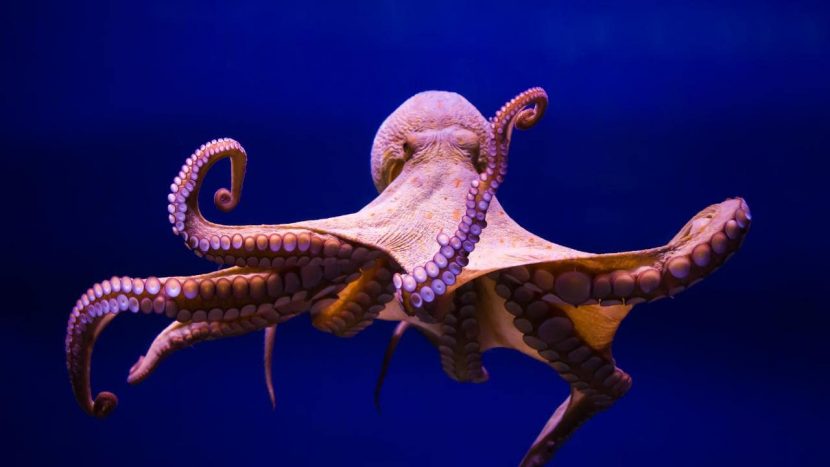
In her book The Soul of an Octopus, Sy Montgomery explores her friendship with a sweet-natured cephalopod named Athena. She proposes that octopuses could be considerably more intelligent than we credit them for, but because their biology and consciousness is so alien to us, we lack the framework to understand how that intelligence manifests itself. This is interesting because humans do tend to have a fairly narrow understanding of intelligence, an area of some contention in schools, where educational progressives argue that stifling systems of standardised testing do not equally favour for the whole spectrum of ‘intelligence’ in childen.

This makes sense. Our school system is a reformed but still fairly intact iteration of a Victorian system, in which a specific set of skills and values would be needed to be economically prosperous in a highly industrialised system. Creativity, emotional intelligence, non-cognitive ability, lateral thinking? These were less useful skills. But our economy has become so much more nuanced and wide-ranging. And it’s changing all the time. Is such an outdated version of economic efficiency really a useful benchmark to measure how our children develop?

The debate is particularly febrile in the grammar school debate, where the educational futures of children is decided by the eleven-plus. Proponents argue that grammar schools allow for greater social mobility and the avoidance of selection-by-wealth; opponents say that it is outdated, and unfair for years of educational privelege to be denied to children who have bad test days. There is a feeling underpinning the pro-comp lobby that a single test cannot possibly define a child’s entire abilities.

It used to be that figuring out intelligence was cut-and-dry. If one child was reading Catcher in the Rye at nine, they were smart. If another child of the same age group had yet to work out how to use doorknobs, they probably weren’t heading for the C-suite. But is this fair? And is it be right that the latter child should face a world full of closed doors?

There is a quote that often crops up online, falsely attributed to Einstein, but still relevant. “If you judge a fish by its ability to climb a tree, it will live its whole life believing that it is stupid.” Narrow ideas of what intelligence means can be destructive, especially when standardised testing is so arbitrary—grades will vary from one teacher to the next, and separating subjects into rigid disciplines renders non-discipline skills irrelevant. Instead of recognising inherent ability, we are not just judging fish on their tree-scaling abilities, but actively testing them on it. Just because an octopus cannot perform well in Key Stage Three maths, does it mean it isn’t intelligent? (Not to mention the number of disciplines that they could excel in given the chance; drumming, for example.)

If we predicate intelligence solely on retention of data and learning by rote, what is left of human ingenuity? AI will soon outperform humans at almost all knowledge-based curricula, from the simple to the complex. In order to escape a dawn of human cognitive obsolesence, it would do well to begin teaching our younger generations what is actually special and unique about the human mind. The way it can interpret art, react emotionally to data, and apply a subjective consciousness across disciplines, rather than reducing everything to pure logic.

Rose Luckin, a professor of learning-centred design at University College London identified seven kinds of intelligence we need to thrive:

1. Interdisciplinary academic intelligence: the ability to tie subjects together rather than understanding them in silos

2. Social intelligence: developing an awareness of our own emotions and how we regulate those in a group

3. Meta-knowing: our relationship to knowledge. The ability to understand what constitutes good evidence and how to make judgements based on evidence.

4. Metacognition: knowing ourselves and regulating our cognitive processes

5. Meta subjective intelligence: understanding our emotions and their relationship to our learning and well-being.

6. Meta contextual intelligence: the dynamic context in which learning takes place

7. Accurate perceived self-efficacy: our ability to assess our own abilities

As our crass understanding of human intelligence develops, it’s no surprise that more innovative educational institutions are gaining popularity. For example, Steiner Schools encourage learning through play until the age of seven, with the aim of developing the “whole” of the child’s mind: academic, physical, emotional, spiritual. As well as instilling a love of learning and enthusiasm for school, this method is designed to foster the imagination and the artistic mind, in order to better apply to a diverse range of traditional academic disciplines, and to produce a strong sense of self. Then there’s Montessori Education, characterised by multi-age classrooms, and based on self-directed activity, hands-on learning, and collaborative play. In an age when empathy and compassion seem sorely lacking, would educational models that encourage these qualities actually benefit the world, socially and economically?

Some purists may argue that new-age learning is inferior to time-honoured traditions, but in a world that is changing more than ever before, and with more information at our disposal about how children learn, it could be that new thinking is desperately needed, in order to prepare children for a totally different type of economy.

You never know; previously under-acknowledged forms of intelligence may well be nurtured and rewarded in future economies. Plus, the animal that marine biologists think is most likely to take over the planet? The octopus. Make of that what you will.

FF Thinker: Martin Morales, CEO and Founder of Ceviche Family

Richard Wallace

This month’s Fearlessly Frank Thinker is Martin Morales, the award-winning Peruvian restaurateur, chef, author, entrepreneur and arts producer. He runs Ceviche Family which includes Ceviche and Andina’s collection of six boutique award-winning restaurants as well as a bakery, record label, and art gallery. He also hosts the YouTube channel Martin’s Peruvian Kitchen, and in the past has worked with Steve Jobs as Head of iTunes Pan EU. As Disney’s main music exec in Europe he helped launch some of the most successful music artists in the world.

Give us one fearlessly frank opinion on the future of food and music.

As the world becomes more judged and led by digital media, people will be increasingly looking for authenticity, tradition and balance. They will look for what’s truly real, has substance and has been shaped over time and not recent hype. Dishes and music with meaning, shaped by a people or a culture – instead of a one-off pop star chef or music artist – will have growing appeal, relevance and impact.

We are scratching the surface in terms of what we know about certain ingredients, instruments, foods and sounds, so a new wave of cultural traditionalist curators and re-creators will emerge to the delight of digitally-burnt-out people.

Is the past a good predictor of the future in your thinking?

No. Not a predictor, but it does propose the future and shapes it too. We need to suffer and be intensely impacted and affected by an era and its challenges to enable new thinking to take place. Without pain, there is no advancement, nor reflection.

How do you think differently to achieve success?

I think laterally, I think in opposites and I so therefore think very broadly. By using those tools, I have the pick of obvious and conservative ideas, fresh new ones and some that may surprise and delight.

I have the scope to look at an incredibly wide variety of solutions and ideas, and then filter them using a set of criteria based on the needed end result. That way I achieve focus and also contingency; real ambitious targets but also some peace of mind.

I also travel to other countries and cultures; I read other industries’ publications and fanzines. I keep my ear to the ground, literally. I watch and watch and watch peoples’ behaviour and likes and dislikes. And I listen to others.

You can always get a feel for the right path forward if you’ve discussed it with a large group of people individually and a majority of those agree on a particular focus. The rest of the group will also help you sculpt the idea, as everyone’s opinion is valid. Everyone is a potential user/customer/fan so why not consider their views?

Listening, watching, sensing, feeling and communicating all come before thinking. When I’m ready, then I make time to daydream and to think. That’s when the best solutions and ideas happen as these are led by gut, knowledge and selflessness.

Thanks very much to Martin for speaking to us!


Superblood and ‘nanofish’ – some of the most out-there medical breakthroughs currently in development

Richard Wallace

In an age when technology is seemingly capable of incredible new breakthroughs, from AI to the driverless car, many of us wonder about how tech will begin to affect our everyday lives. We often hear speculations that modern science, thanks to innovations in medical technology, will prolong not just our quality of life but also our actual lifespans, even at the same time as climate fears compel us to prevaricate about the colonisation of new planets.

One modern tech company trying to make headway in the medical space is Rubius Theraputics, a startup currently developing a genetically-engineered ‘superblood’ to battle cancer, as well as a range of other illnesses. So far Rubius has raised $200 million from investors in under a year.

This sci-fi-sounding ‘superblood’ involves genetically-manipulated red blood cells which lack a nucleus and can thus evade the autoimmune system in order to carry therapeutic proteins all over the body, theoretically allowing doctors to replace missing enzymes, kill tumours, and even regulate the immune system to battle autoimmune diseases. The cells are calibrated to treat specific conditions affecting specific organs, and are administered by transfusion, ultimately replacing less than 1% of the total blood in the body.

In 2017 the Food and Drug Administration first approved two highly personalised cancer versions of cell therapy, although the ultimate idea is that Rubius won’t need to create personalised solutions—their superblood will eventually be a way of providing novel cellular therapies on an off-the-shelf basis. The current superblood, however, is made from an individual patient’s white blood cells (the part of the body’s immune system responsible for combating infections and foreign substances) which are then reengineered to recognise and destroy cancer cells. The reprogrammed cells are sent back and administered to the patient.

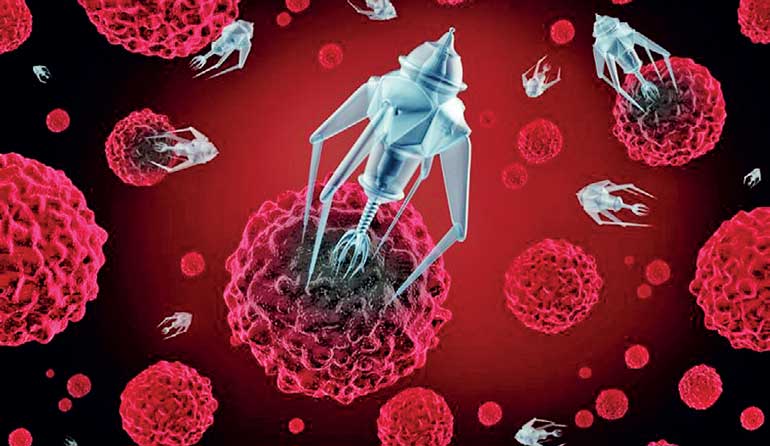
However even superblood sounds tame next to what researchers Jinxing and Tianlong Li have created: a tiny ‘nanofish’ designed to ‘swim’ through the bloodstream, delivering drugs to specific sites in the body. These nanobots, created from gold, silver and nickel, are even smaller than red blood cells—100 times smaller than a grain of sand, to be precise—allowing surgeons to deliver medicine more precisely, manipulate single cells or even perform non-invasive surgery.

In other words, we may be nearing the day that some of the most difficult surgical and therapeutic challenges currently faced by medical science are met with daring, forward-thinking solutions. It can be easy to focus on the negatives of scary-sounding technologies such as AI and nanorobotics, on the basis of how these new technologies could be militarised—but we should also remember that they may end up saving our lives.